
Canopy and the Architecture of Focus
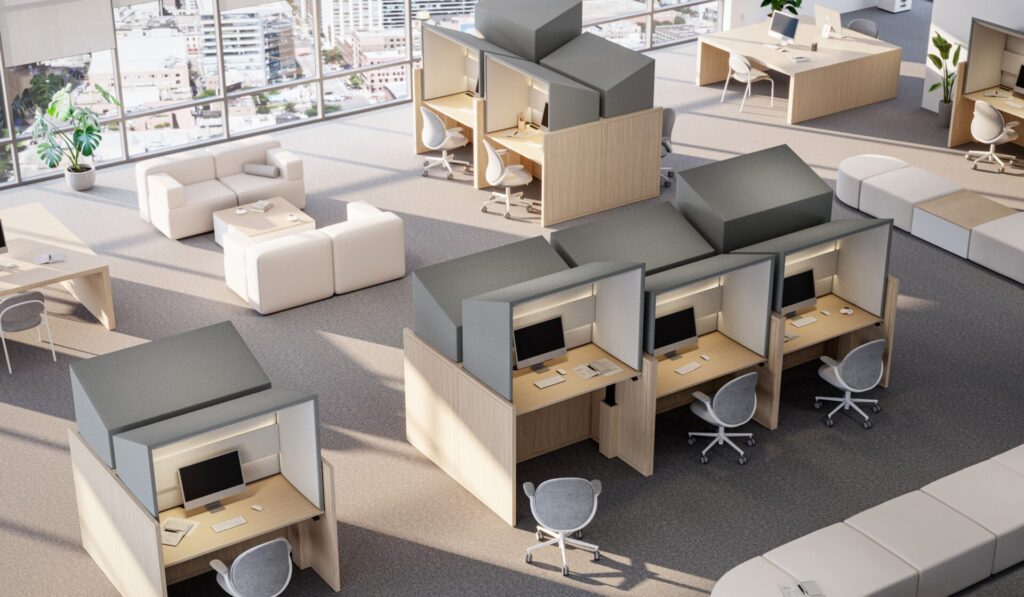
Focus has become a design problem, not a personal one. Canopy, developed by KFI Studios in collaboration with Gensler, approaches that challenge architecturally rather than behaviorally. The freestanding workstation introduces calm and enclosure within open environments, without retreating from them.
Canopy belongs to a growing class of acoustic workstations that behave less like furniture and more like spatial infrastructure. Its form is disciplined. The upholstered hood establishes a sense of boundary, while the overall footprint stays compact enough to integrate into dense floorplates. It reads as composed and purposeful, never bulky.
Materiality carries much of the experience. Upholstery softens sound and light, while the lower surround, available in wood veneer, laminate, or fabric, gives the piece architectural weight. Designers can specify contrast or continuity depending on context. Integrated lighting is intentionally quiet, supporting focused tasks and video calls without visual clutter.
What makes Canopy especially relevant is how it supports planning logic at scale. These acoustic workstations help organize open environments into zones of focus, similar to how lounge groupings or soft dividers operate elsewhere in the office. There’s a clear parallel to the comfort-forward strategies explored in Lounge Seating with a Playful Edge, where performance and ease coexist without slipping into informality.
For projects balancing density, flexibility, and sustainability, Canopy feels resolved. Built in the USA with FSC-certified wood and low-VOC finishes, it frames privacy as a design decision rather than a compromise. This is not about escaping the office. It’s about designing focus into it.
Images Courtesy of KFI Studio


Ready to spec what you see? Try Designer Pages PRO free for 30 days.
Related Posts


Leave a Reply